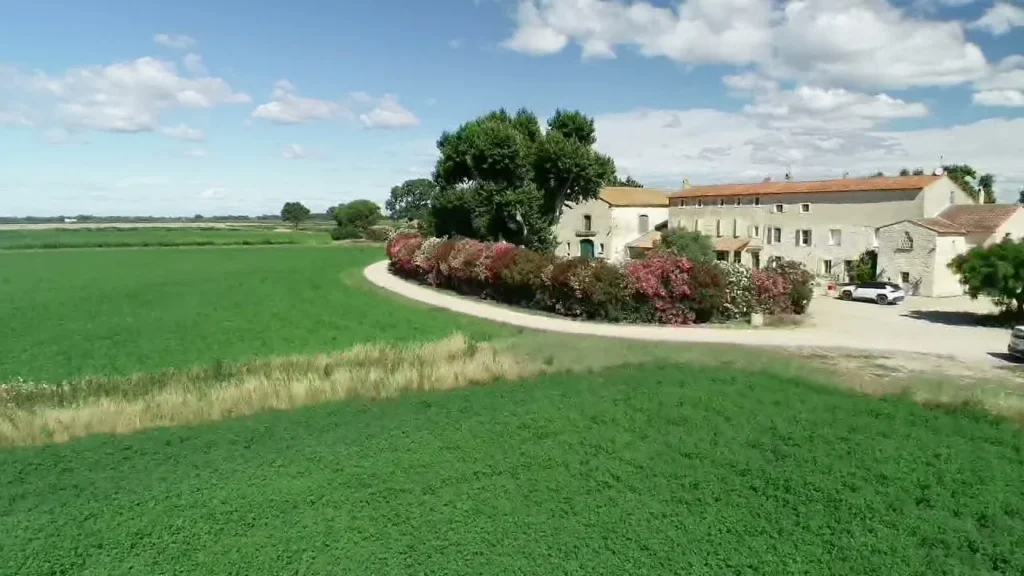
The farm: a year of rice growing
Through the seasons, here is the work taking place right outside your windows.
The winter months
They are devoted to preparing the soil for the future rice fields: disc harrowing, ploughing, harrowing and laser levelling. Rice-growing work begins in April.
Flooding the fields
Base fertiliser has to be spread, then the fields are harrowed again to work it in. If the temperature allows, the rice fields are flooded.
Water is pumped from the Rhône and sent into large canals serving about twenty properties, which share the costs of maintenance and supervision. Each owner opens small sluice gates, called “martelières” in the Camargue, and directs the water through countless small channels, the “porteaux”, to the rice fields, which fill up.
Sowing
This is the most important and most critical period: a large part of the future harvest depends on it. The rice is sown in the water using tractors fitted with iron wheels, the “skeleton wheels”, which do not sink thanks to the very firm layer of soil created by deep working.
The crop must then be treated to prevent the spread of weeds, which are hardier than rice. During germination, the predators of rice, including flamingos, rush onto the young seedlings. Warm, windless weather is precious: germination is then fast and strong. At the end of May, the rice emerges from the water and the fields turn a tender green.
Growth and flowering
The rice grows. Towards the end of the month, the first ears appear on the earliest varieties; they flower within a few days and begin fertilisation.
All the varieties flower in turn, another moment of great danger: if the temperature drops below 14 °C, the grains die and produce only empty ears. That is why several varieties, early and late, are grown to spread the risk.
The harvest
The rice is ripe and the harvest begins. Tracked combine harvesters enter the rice fields, drained in August but still very wet, and leave deep ruts that will have to be levelled as soon as the soil is dry: only the mistral can remove this moisture.
At the end of the harvest, the rice is sent to the silos of the large rice mills, which store it, dry it, sort it by variety and deliver it to the merchants who package it for retail.
The harvest results
Yields in the Camargue are around 6,000 kg per hectare, with enormous differences from one plot to another: sometimes 9 tonnes in good years, 3 tonnes on another plot. On average, 5,000 kg per hectare are needed to cover the costs of a very expensive crop.
Every rice grower is passionate about the job and, if the year has been poor, they always hope the next will be better. To taste our rice, visit the Camargue rice shop.